A practical guide to building a high-performing video strategy
If you’re responsible for growth, video sits in the middle of a messy set of expectations. Leadership wants proof. Sales wants pipeline support. Your audience wants clarity. Your team wants a process that doesn’t collapse under constant requests.
Over the last few years, making videos has become easier, while getting results has become harder. AI has increased volume and attention has gotten more expensive. One of the biggest risks now is shipping content that looks and feels like everything else.
AI-generated video has been woven into our content feeds and that comes with a second-order problem: your audience is scrolling past (and even reporting) AI slop. Building trust is part of the job now.
This guide walks you through how successful video production actually happens in 2026 — smaller teams, more stakeholders, faster cycles, and less patience for work that can’t directly be tied back to business outcomes.
What you’ll learn
In this guide, we’ll cover how to:
Set video marketing/strategy objectives that hold up under budget scrutiny
Choose audiences and channels with enough precision to win
Build a workflow that supports speed without sacrificing clarity
Test and iterate without turning your team into a content factory
Measure success in ways that make sense to stakeholders
Scale what works, while keeping goals and standards intact
You’ll hear from Storyblocks’ in-house team, industry experts, and enterprise partners who run successful modern video programs. They’ve learned what holds up when volume is high, timelines are tight, and expectations keep rising.
Featured experts
Kyle Denhoff — Senior Director of Marketing, HubSpot
Kaitlyn Rossi — Creative Director, Storyblocks
Naomi Liddell — Content Lead, Doist
Kirsti Lang — Content Creator, Buffer
Ron Dawson — Content Marketing Lead, Replit
Kyle Miller — Video Production Manager, Storyblocks
What is a video strategy?
Simply put, a video strategy is your roadmap to navigate the entire video process — from planning to production, all the way through to distribution and scaling.
Today, a video strategy also defines how your team operates. It outlines how ideas move from concept to execution, how quickly content can be produced, how teams collaborate across functions, and how performance informs future output.
Your strategy has to align every video to your business goals, so you can hit your revenue targets and convince stakeholders to invest more in your content.
Why do you need a video strategy at all?
For many teams, the pressure is not just producing video, but producing the right video — quickly, consistently, and in a way that supports measurable business outcomes.
Over 40% of companies make at least one video a week. Among them, mid-sized companies make about three a week— twice as many as they did in 2023(Wistia, State of Video Report 2025)
53% of respondents indicated that they plan to spend $5,000 or less on their projects, while 20% reported plans to spend $15,000 or more (Lemonlight, 2026 Video Marketing Stats)
The three challenges that slow or stall video programs
Many teams don’t struggle with video creation — they struggle with the absence of a clear video strategy.
There’s often a disconnect between what the business expects from video, how teams actually produce it, and how success is measured. Without a shared direction, even well-resourced teams face friction at every stage of the process.
Three common issues weigh down video creation for companies — and they’re still largely about time and money. But today, they also include operational complexity, production pressure, and shifting expectations around what a “good” video looks like.
1. Insatiable demand for video puts strain on creatives
Today, people turn to every platform — from Spotify to LinkedIn — for relevant video content. They evaluate ideas, execution, and even subtitle text fonts for quality and consistency — and are not forgiving.
This relentless hunger for more high-quality video from brands can drive teams to the point of burnout. Creatives need to find new, exciting ways to compete for attention spans, and that can be hard to do when they’re constantly required to produce.
“We need to turn out content a lot faster these days. Coming up with new creative ideas and reinventing formats to continually delight your audience while also keeping up with the content engine is a tough challenge. There’s a lot of content out there competing for your audience’s attention so you need to show up often and with real effort.” — Kaitlyn Rossi, Creative Director, Storyblocks
Without clear processes, this demand can quickly overwhelm even well-resourced teams.
2. Too many stakeholders slow down production and dilute direction
People have strong opinions about tone, style, pacing, visuals, and messaging. But without clear ownership, video teams can get stuck debating creative preferences instead of executing against strategic goals.
This leads to:
Longer production timelines
More revisions and rework
Loss of creative direction
Strong video programs require clear decision-making authority. Someone must define the objective, align the team, and make final calls.
As Ron Dawson, Content Marketing Lead at Replit, puts it, “It’s important to have someone in the room where the buck stops — someone who hears everyone’s opinion and makes the final call on the direction.”
Without this structure, production slows, quality becomes inconsistent, and teams struggle to scale their output.
3. Misaligned expectations make it hard to advocate for the value of video
Everyone wants their videos to perform well. But getting your stakeholders to agree on what that actually means is tricky.
Many organizations also struggle to connect video performance to broader business outcomes, like pipeline, revenue, or customer engagement. Without shared success metrics, teams find it difficult to justify continued investment or scale their programs effectively.
The good news? You can overcome all of these challenges with the right video strategy (which is probably why you’re here, after all).
How to create your video strategy
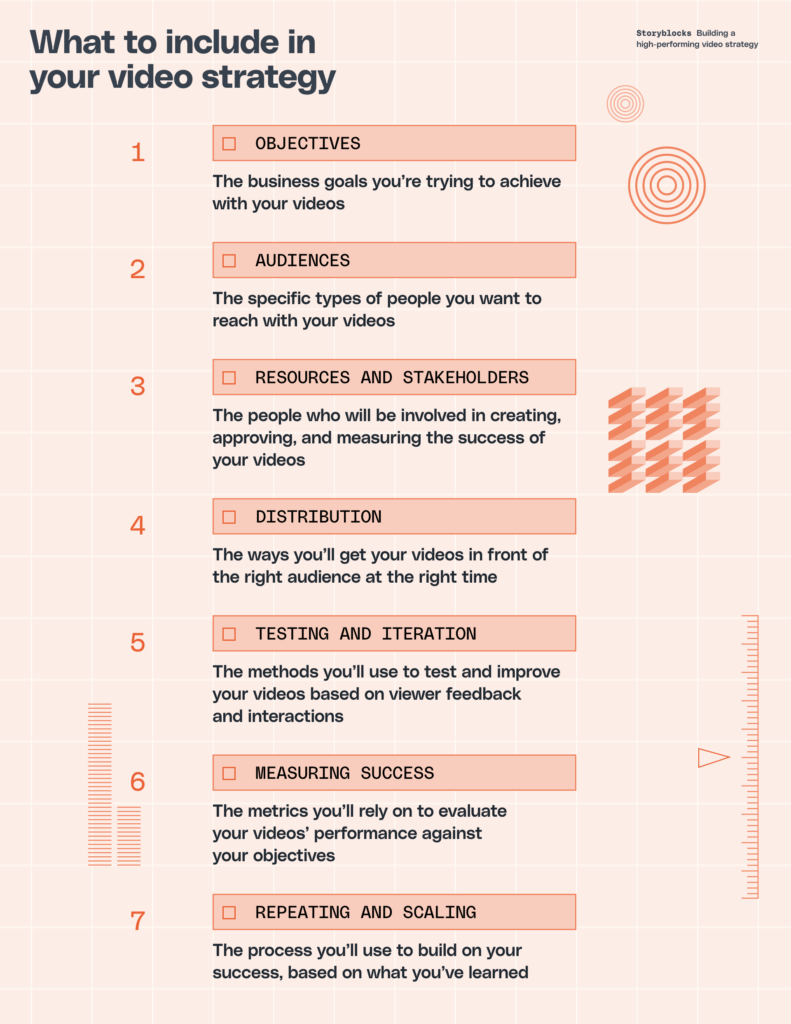
Let’s get down to brass tacks. Here are the essential parts that make up a successful video strategy:
Together, these elements help teams move from ad-hoc video marketing to a repeatable operating model — one that supports faster execution, clearer decision-making, and measurable business impact.
The sections below walk through how to define each component so your video efforts stay aligned with your organization’s priorities and scale sustainably over time.
How to set your objectives
The most important part of your strategy is setting the objectives. It might sound dramatic, but the last thing you need is to spend time, budget, and creative energy on videos that have no clear direction.
Everything you do from here on out should help you achieve the objectives you set at the beginning — whether that’s increasing brand awareness, educating your audience, driving conversions, or supporting long-term brand positioning.
But in today’s video landscape, objective-setting has evolved. It’s moved on from business-only goals and into the realm of audience relevance.
For Kyle Miller, Storyblocks’ Video Production Manager, there’s a single question he uses to keep his audience in mind: “When I’m scripting or creating a video, I keep asking one question: “Who cares?” You have to imagine someone scrolling through thousands of videos — why would they stop for yours?”
That audience-first mindset should shape every objective you define.
Start with audience value, not just internal goals
Traditional video strategies often start with what the company wants to say. Contemporary strategies start with what the audience needs.
Your objective should clearly answer:
What problem does this video solve?
Why should someone stop scrolling?
What value are we delivering immediately?
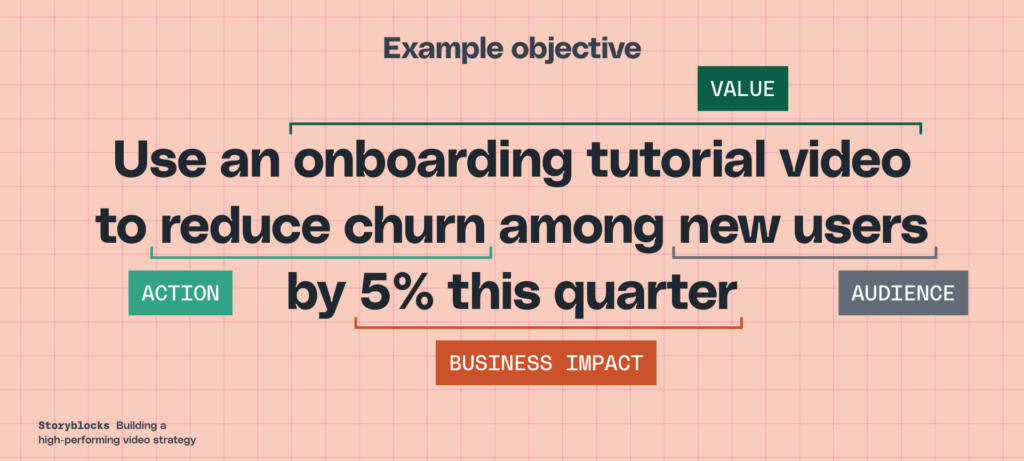
Define your objective in one simple statement
A strong objective should:
Be written in one sentence
Describe a single outcome
Define the audience and action
Connect directly to business impact
Clear objectives reduce production friction and improve stakeholder alignment. They also help teams move faster.
“Organizing your thoughts, drilling down and simplifying the idea of a video as much as you can before you begin it — make it as simple as you possibly can.” — Kyle Miller, Video Production Manager at Storyblocks
Balance business impact with creative execution
In addition to connecting video output to business outcomes, your objective also needs to account for how video actually gets made today — through testing and iteration. Modern teams prioritize speed and experimentation over perfection.
“We changed our mindset to ‘Great is better than perfect.’ We started getting more creative out the door, experimenting more, and delivering more variations of the same concept. And by that, we can figure out what parts are really the strongest.”— Kyle Miller, Video Production Manager at Storyblocks
Your objectives should therefore enable testing.
Instead of:
“Create the perfect campaign video.”
Think:
“Test three messaging angles to improve conversion rate.”
“Increase engagement through short-form educational content.”
“Validate audience interest in a new product positioning.”
Make your objectives achievable with your current resources
Many video teams today work with limited resources and competing priorities. Objectives that ignore those constraints create bottlenecks.
Your strategy should reflect that reality by setting goals that teams can realistically execute.
“Everyone agreed that video mattered,” Naomi Liddell, Content Lead at Doist explains. “But getting on camera is a very different commitment, and it’s not something people tend to casually volunteer for. I remember looking around, thinking, “Right… is someone going to raise their hand?” And eventually it became clear that if it was going to happen, it was probably going to be me. Thankfully, no one expected polished perfection. All I promised was honest progress. We treated it like an experiment, and it worked.”
Align objectives with how modern audiences consume video
Audience behavior has shifted significantly because attention is fragmented and content competition is high. To make it even more challenging, niche audiences expect relevance, emotion, and connection throughout long formats.
This changes what success looks like.
“How you speak to the viewer has an outsized impact. People don’t just watch for information. They’re tuning in to how you make them feel. So I imagine I’m talking to one smart friend when I’m filming. Once I really internalized that, my presentation style fell into place.” — Naomi Liddell, Content Lead at Doist
Your objective should therefore prioritize:
Immediate value delivery
Strong opening hooks
Relevance to a specific audience
Clear next actions
Define success before production begins
Your objective should make success measurable.
Before production starts, define:
The outcome you want
How you’ll measure it
What success looks like
How you’ll pivot if results fall short
Clear success criteria help teams move faster and make better creative decisions.
How to identify and reach your target audience
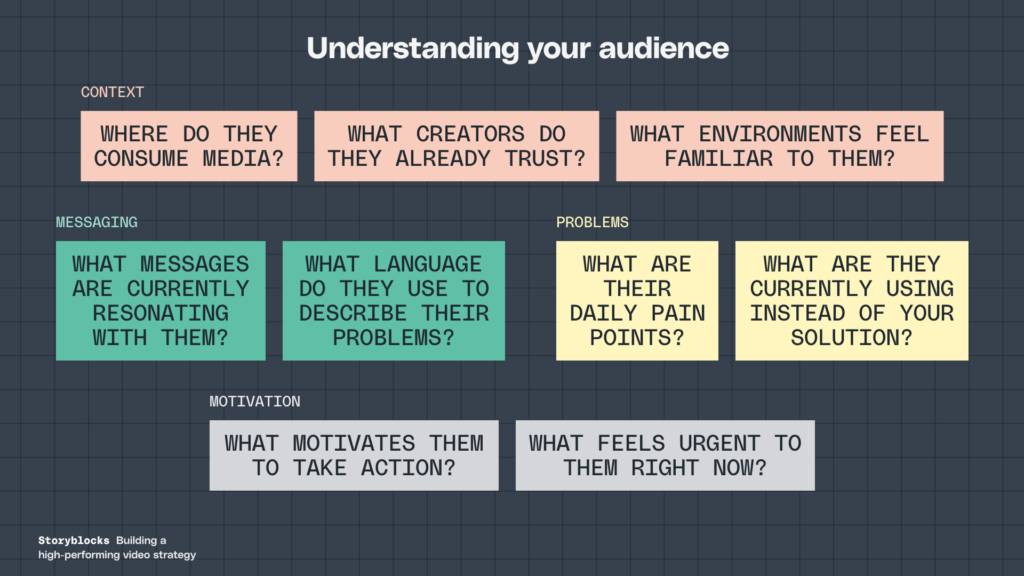
A strong video strategy starts with clarity about who you’re creating for. Defining an audience requires understanding how people consume content, where they focus their attention, and what they expect from different platforms and formats.
1. Study real behavior, not assumptions
Contemporary video teams build audience insight from observable behavior rather than internal assumptions. The starting point is understanding how people actually consume information and make decisions.
“I talk to our customers and ask them what they’re doing — what are your media consumption habits? Do you listen to podcasts every week? Do you read newsletters every week? Then, we look at the market data and where people are getting their information. Once we have all of that, we make a prediction around where people are going and make investments there.” — Kyle Denhoff, Senior Director of Marketing at HubSpot
The goal is simple: understand how your audience actually spends time and where they seek value.
2. Let audience expectations shape your format
Different audiences have different expectations. When a video’s format — such as a long-form tutorials, short social clip, or product walkthrough — conflicts with those expectations, performance suffers regardless of production quality.
When scripts or ideas start feeling formulaic, I go back to our audience. I spend time looking at their words, their problems, feedback, and comments. I immerse myself in their tone and try to figure out from them what they need from us right now, rather than what we want to say.
Naomi Liddell
Content Lead at Doist
3. Look beyond competitors for inspiration
Many brands define their audience strategy by studying what competitor brands do. This often leads to predictable content and limited differentiation. A better approach is to look to creators and publishers who have already earned trust with the audiences they want to reach.
“A large segment of our audience [at Storyblocks] are video editors, producers, filmmakers so we look for inspiration from creators and social accounts that celebrate the craft and nuances of production,” says Kaitlyn Rossi, Storyblocks’ Creative Director.
“That helps us understand what content will feel familiar and relatable. But we also look at marketing from brands in entirely different industries like fashion and tech to see what’s pushing the boundaries in those spaces. That helps us think creatively and out of the norm.”
These signals reveal what your audience already values — and what they’re likely to respond to.
4. Single out the one action you want your audience to take
If your video’s goal is to get your audience to do something, establish what that action is as early as you can. Remember your objectives? This is where you align those with your audience — by defining a specific next step you want your audience to take.
“We start every video we make by clarifying a specific goal,” Kaitlyn Rossi explains. “For example, we make different video creative for ads where the goal is to convert prospects to customers than we do for ads where the goal is to drive exploration of our product. The messaging, length and even concepts vary based on the intended outcome.”
How to establish your resources and stakeholders
A contemporary video strategy is not just a content plan. It’s an operating model.
To produce video consistently — and see meaningful results from it — your team needs clear ownership, defined workflows, and shared expectations across everyone involved. Without this structure, even strong ideas stall in production, approvals slow down, and output becomes inconsistent.
This part of your strategy defines how video actually gets made inside your organization.
Clarify ownership and decision-making early
Video production often involves multiple teams — marketing, brand, product, leadership, and external partners. When roles are unclear, priorities compete with each other.
Start by defining who owns each stage of the process.
Who sets the objectives?
Who approves creative direction?
Who measures performance?
Who decides when a video is finished?
Clear ownership reduces delays and keeps production moving.
“When too many people are involved in the creative process, the work gets diluted. Everyone adds their opinion, and you end up with something safe instead of something effective. The strongest teams are the ones that trust a small group to execute and move quickly” — Ron Dawson, Content Marketing Lead at Replit
The goal is faster progress, not less collaboration.
This expands production capacity and brings more perspectives into your content.
“Having people on your team who aren’t video creators by background — but who know the basics of video creation — will definitely help increase your resources,” says Kaitlyn Rossi, Creative Director at Storyblocks.
The role of specialists also evolves. Instead of handling every task, they focus on creative direction, quality, and high-impact storytelling.
Win stakeholder buy-in by connecting your video to business outcomes
Even the strongest strategy will stall without internal support. Leadership teams want to understand how video contributes to growth.
Buy-in happens when video is positioned as a driver of measurable outcomes — audience growth, lead generation, customer education, or revenue impact. That connection needs to be defined before production begins (and occasionally defended while production happens).
Kyle Denhoff explains how his team at HubSpot Media approaches this alignment:
“We look at the historical performance of our channels and forecast where we think we’ll be. Then we look at where the business needs us to be — and we figure out how to close that gap.”
This approach ties video initiatives directly to business expectations rather than treating them as isolated creative efforts.
You also need clarity around what each individual video or campaign will achieve. No one video can deliver on multiple objectives.
When you help stakeholders understand the intended outcome — awareness, engagement, or conversion — expectations become realistic, and support becomes easier to secure.
How to distribute your videos effectively
Creating a video is only half the work. Distribution determines whether that work drives business results.
Contemporary video strategies treat distribution as a strategic decision — not an afterthought. Where your video appears, how it’s packaged, and what action it drives should all be planned before production begins.
Distribution choices should always connect three things: your audience, your objective, and the context in which the video will be consumed.
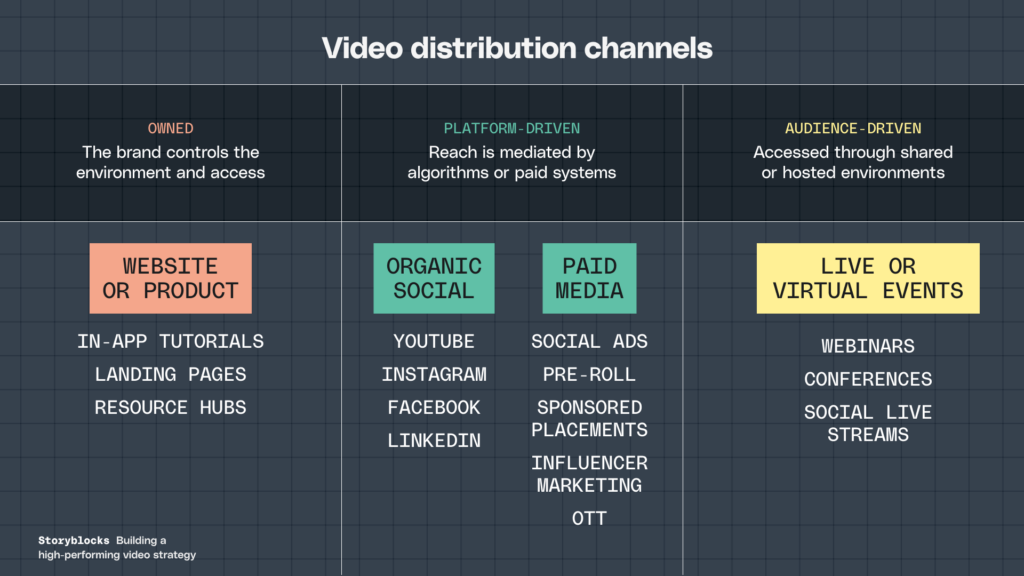
Match the video to the platform — not the other way around
Each platform has its own audience behavior, expectations, and role in the customer journey. A video that performs well in one context may fail completely in another.
“You need to cater the content to the channel and take full advantage of what each platform does well. They all have different mechanics and expectations, and you need to adapt if you want performance.” — Kyle Miller, Video Production Manager, Storyblocks
This often means different objectives across channels. Some platforms drive awareness and trust. Others drive conversion. For example, Storyblocks approaches YouTube primarily as a trust-building channel rather than a direct conversion driver.
“We’re trying to build customer loyalty and brand reputation,” says Kyle Miller. “We want people to understand what Storyblocks does, associate value with it, and become fans of the brand. Conversions come more from paid channels, but organic video builds trust.”
Distribution isn’t just about immediate results. It strengthens the entire content system around it.
Funnel stage
Distribution channel
What it does
Metrics to track
Awareness
Social media — Paid
Promotes video content to targeted audiences on platforms like LinkedIn, YouTube, Instagram, and Facebook to expand reach and generate initial engagement quickly.
• Cost per view (CPV) • Reach and impressions • Engagement rate (likes, shares, comments) • Video completion rate • Click-through rate (CTR) • Audience growth
Paid advertising
Distributes video through ad networks such as display, programmatic, or pre-roll placements to drive brand awareness at scale.
• Impressions and reach • View-through rate • Cost per thousand impressions (CPM) • Brand lift or awareness indicators • Frequency • Cost per acquisition (CPA)
Paid syndication
Distributes video through publisher networks or third-party platforms to reach audiences beyond owned channels and expand visibility.
• Cost per lead (CPL) • Engagement rate • Content consumption • Audience quality • Lead volume • Conversion rate
Consideration
Website — Organic
Hosts videos on landing pages, product pages, and blogs to educate visitors and move them toward conversion.
• Video plays and watch time • Page engagement time • Bounce rate impact • Scroll depth • Lead generation rate • Conversion rate
SEO — Organic
Optimizes video content for search visibility (YouTube SEO, video search results, embedded content) to capture high-intent traffic over time.
• Search rankings • Organic traffic • Click-through rate from search • Watch time • Session duration • Inbound leads
AEO/GEO
Optimizes video content to surface in AI overviews, generative search responses, and answer-driven discovery experiences. Helps your videos appear in AI-generated summaries, featured snippets, voice search, and large language model citations — expanding visibility beyond traditional search rankings.
• Impressions from AI overviews / generative search features • Video appearances in featured snippets or answer boxes • Referral traffic from AI-driven search interfaces• Average watch time from search-discovered viewers • Backlinks or citations driven by AI-surfaced content
Live video
Delivers real-time experiences like webinars, live streams, and events to build trust, demonstrate expertise, and encourage interaction.
• Registrations vs attendance • Live viewers and peak viewers • Engagement (questions, comments, participation) • Average watch duration • Post-event engagement • Pipeline or lead impact
Conversion
Digital ads — Paid
Uses video in performance-driven campaigns such as retargeting or funnel acceleration to convert engaged audiences.
• Conversion rate • Cost per conversion • Return on ad spend (ROAS) • Retargeting performance • Pipeline contribution • Revenue impact
Prioritize clarity, testing, and learning
Distribution strategies improve through measurement and iteration. Teams that succeed treat distribution as an ongoing experiment rather than a fixed plan.
“Before starting anything new, state your goal, define what success looks like, and decide how you’ll measure it,” Kyle Miller explains. “Have your hypothesis, know your exit ramp, and give it time. Video work is long-term — you may not see impact for three to six months.”
This clarity prevents teams from chasing trends without understanding whether they work.
Focus your effort where you can execute well
One of the biggest distribution mistakes is trying to be everywhere at once. Spreading resources too thin weakens consistency and quality.
Strong distribution prioritizes depth over breadth — consistent value in the right place rather than inconsistent presence everywhere.
You shouldn’t try to be everywhere if you don’t have the resources to execute properly. It makes more sense to start with one channel, set a clear goal, and become reliable there.
Kyle Miller
Video Production Manager at Storyblocks
How to improve your videos by testing and iterating
Even the most experienced teams don’t get video strategy right on the first try. The strongest programs improve over time by testing ideas, learning from real audience behavior, and reinvesting in what works.
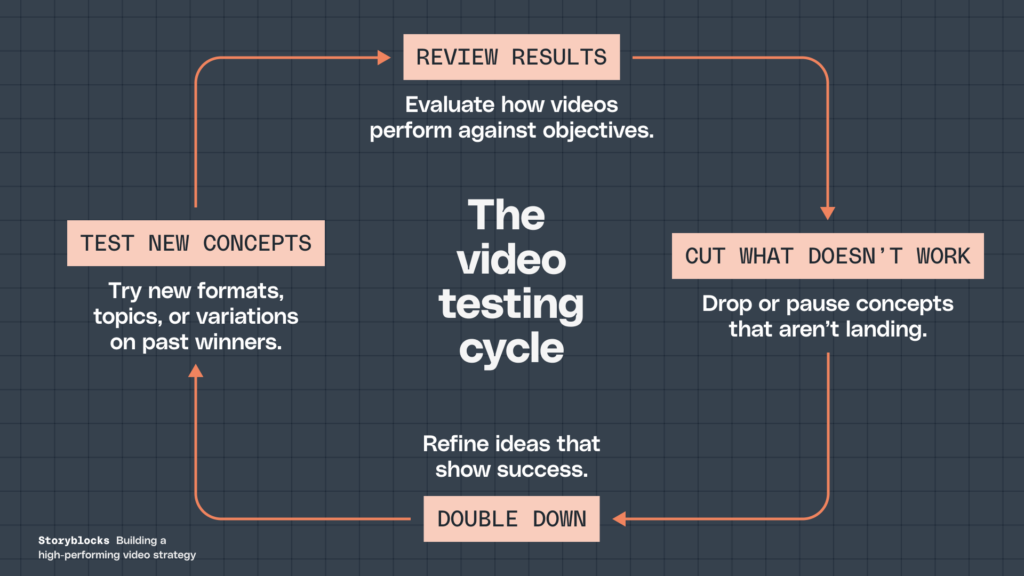
Contemporary video strategy is built on continuous learning. Teams form hypotheses, launch experiments, measure performance, and refine their approach based on what the data reveals. Over time, this creates a repeatable system for producing videos that deliver real business impact.
Form hypotheses and run experiments
Once your goal is clear, experimentation becomes purposeful.
Leading teams treat video production as an ongoing cycle of hypothesis and validation. They test ideas in the market, observe results, and scale what performs well.
Kyle Denhoff describes this process at HubSpot Media:
“We run experiments. Someone has a hypothesis, we test it, and if it works, we reinvest in it again. A lot of what we do is crawl, walk, run — we try something, see what happens, and then double down on what performs.”
Let audience behavior guide decisions
One of the biggest lessons from the experts is simple: audience response matters more than internal preference.
Ron Dawson shared how his own assumptions were challenged by performance data:
“It didn’t matter what I liked. I preferred long, narrative interviews, but our audience [at Frame.io] responded to technical content. So the question becomes: what does the data and your audience tell you?”
This principle applies across formats, platforms, and creative choices. Teams may have strong opinions about storytelling style, production quality, or messaging, but sustainable video strategies follow evidence.
Testing reveals:
What audiences actually watch
What keeps them engaged
What drives action
What supports business outcomes
These insights should shape future production decisions.
“On our team, we’ve all been wrong many times about how our audience will perceive and react to different video creative. The most important thing is to learn from failed hypotheses and trust what the data is telling you about what is connecting with your audience. What you meant to say ultimately doesn’t matter. It all comes down to if they receive it.” — Kaitlyn Rossi, Creative Director, Storyblocks
Scale what works and refine continuously
Testing is not a one-time activity. It’s an ongoing process.
When an experiment succeeds, teams reinvest in that direction and refine execution. When something underperforms, they adjust quickly or try a new approach. Over time, this creates a stronger, more efficient video program.
“We put things out, test them, and if they work, we invest more. We’re always trying new formats — and sometimes we get it wrong. We once introduced a storytelling series on a YouTube channel that was built around educational content. The videos were good, but viewership dropped because the audience had subscribed for education, not stories. That taught us to listen closely to what the audience actually wants.
On the flip side, we also experimented with a podcast-style channel we didn’t expect to generate leads. But by creating practical guides that bridged the episode to a specific action, we found it could drive conversions. That iterative process helps us learn what works and refine from there.” — Kyle Denhoff, Senior Director of Marketing, Hubspot
As distribution channels evolve and tools like AI reshape production workflows, experimentation ensures teams stay responsive rather than reactive.
Balance experimentation with strategic focus
Testing must remain aligned with the overall objective even when demand across the organization skyrockets. More ideas and opinions can create noise, making it harder to stay focused.
Successful testing programs maintain clarity of purpose. Every experiment should help the team move closer to its strategic goals.
As teams scale, you get more people involved and more opinions. The hardest thing to protect is the objective. You need someone who can make the final decision and keep everyone aligned with what the video is meant to accomplish.
Ron Dawson
Content Marketing Lead at Replit
How to measure your videos’ success
A contemporary video strategy measures whether the video achieved the outcome it was designed to drive.
Before you look at metrics, return to your objective. What was this video supposed to do for the business? Generate awareness? Educate prospects? Convert leads? The right success signals depend entirely on that goal.
When teams skip this step, they end up optimizing for the wrong outcomes — chasing reach when they need conversions, or focusing on engagement when the real goal is retention.
Success starts with alignment between goal → format → metric.
Map metrics to business outcomes
Different videos serve different roles in the customer journey. Each requires a different definition of success.
“Video needs to map to the goal,” says Kyle Denhoff. “There are specific channels and specific videos that are mapped to specific outcomes. A product tutorial might not get a lot of likes, but it gets people to use the product. A podcast interview might not drive sales, but it builds brand visibility.”
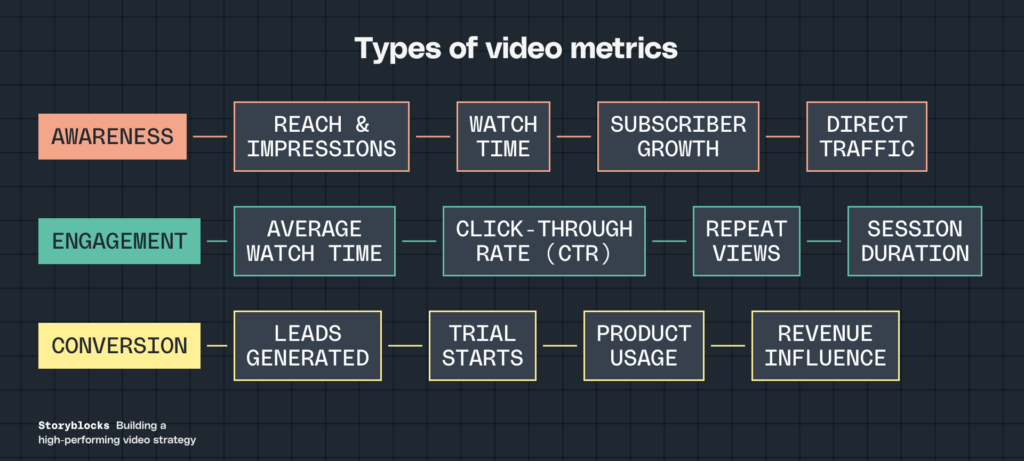
If your goal is awareness or brand reach, you may track:
Reach and impressions
View count and watch time
Audience growth or subscriber increases
Brand search lift or direct traffic
If your goal is engagement or education, focus on:
Average watch time and completion rate
Click-through rate (CTR)
Repeat views
On-page engagement or session duration
If your goal is conversion or pipeline impact, measure:
Leads generated
Signups or trial starts
Product usage after viewing
Revenue influence
The important shift is this: metrics should reflect impact, not just activity.
Look beyond surface-level performance
High view counts can be misleading. A video might attract attention but fail to move the audience closer to action.
“When I ask what the objective is, people say they want the video to go viral or get a lot of views. That’s a success metric, but it’s not an objective. What do you want the video to make people do? Is it meant to get people to pick up the phone? To learn more about your product? To keep coming back? Understanding that determines how you measure success.” — Ron Dawson, Content Marketing Lead at Replit
This distinction keeps teams focused on outcomes that matter.
Use performance data to guide future decisions
Measurement is not the final step — it informs what happens next. The strongest video programs treat performance data as input for future strategy, not just reporting.
Ron Dawson describes how performance data reshaped his content approach:
“You look at the numbers and ask — is this achieving what we’re trying to achieve? If it is, you lean into that.”
Performance data helps teams decide:
Which formats to scale
Which channels to invest in
Which creative approaches resonate
Which experiments to run next
Measurement closes the loop between production and iteration.
Tools for creating your video strategy
Behind every successful video program is a setup that helps teams create quickly, stay organized, and keep improving over time. The right tools make it easier to turn ideas into videos, collaborate smoothly, and keep your production moving without friction.
From planning and production to distribution and measurement, each part of your workflow depends on tools that support speed, flexibility, and consistency. When everything works together, your team can focus less on logistics and more on creating videos that deliver results.
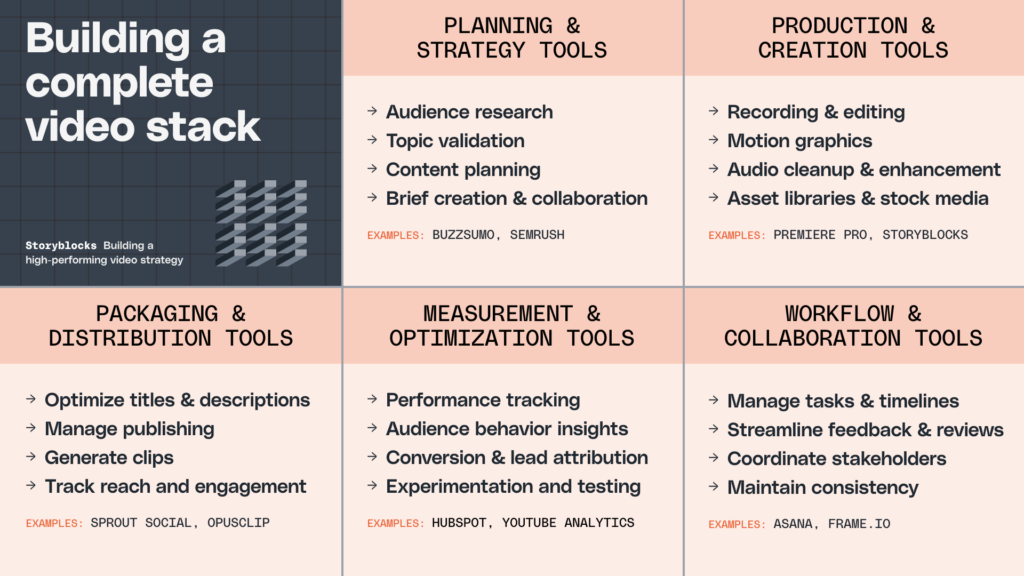
In this section, we’ll walk through the core tools that support a modern video strategy:
Planning and strategy tools that help you define direction and organize ideas
Production and creation tools that support recording, editing, and asset creation
Packaging and distribution tools that help your videos reach the right audience
Measurement and optimization tools that track performance and guide improvements
Workflow and collaboration tools that keep projects on track
Planning and strategy tools
Every effective video program starts with a clear direction. Planning tools help teams align on goals, define audiences, and translate ideas into executable briefs.
Production tools determine how quickly your team can turn ideas into finished videos. Modern teams prioritize flexibility and speed without sacrificing quality.
No single tool creates a successful video strategy. High-performing teams combine tools across planning, production, distribution, and measurement to create a repeatable system.
AI is now embedded across video workflows — but in practice, most teams use it to accelerate production rather than replace creative decision-making. It helps reduce manual work, speed execution, and remove technical barriers, while strategy, storytelling, and brand voice remain human-led.
Across interviews, a consistent pattern emerged: high-performing teams treat AI as a support layer inside their process.
As Ron Dawson explains:
“There’s a balance between staying connected to the human element and using technology in a way that makes sense. AI is here to stay, so people need to understand how to use it and when it makes sense — when to use it and when it doesn’t.”
Kirsti Lang describes how her team at Buffer uses it inside day-to-day workflows:
“I use AI to help draft scripts faster, which significantly speeds up that part of the process. I also use AI features baked into tools like auto-editing to remove pauses and dead space, background removal, transcript generation — those smaller support features are really helpful.”
Similarly, teams use AI to reduce production friction and speed execution without removing creative oversight.
Even when AI generates content, human judgment remains central to quality and effectiveness.
It’s not like someone just types a sentence into a prompt and an amazing video comes out. There’s still a lot of work that goes into making AI video — a lot of creativity. It can reduce the number of people involved, but it doesn’t remove the creative process.
Ron Dawson
Content Marketing Lead at Replit
The role of AI, then, is operational. It helps teams move faster, test more ideas, and scale production — while keeping strategy, audience understanding, and brand voice firmly in human hands.
A strong video stack doesn’t rely on AI alone. It uses AI where it accelerates execution without weakening trust, quality, or creative direction.
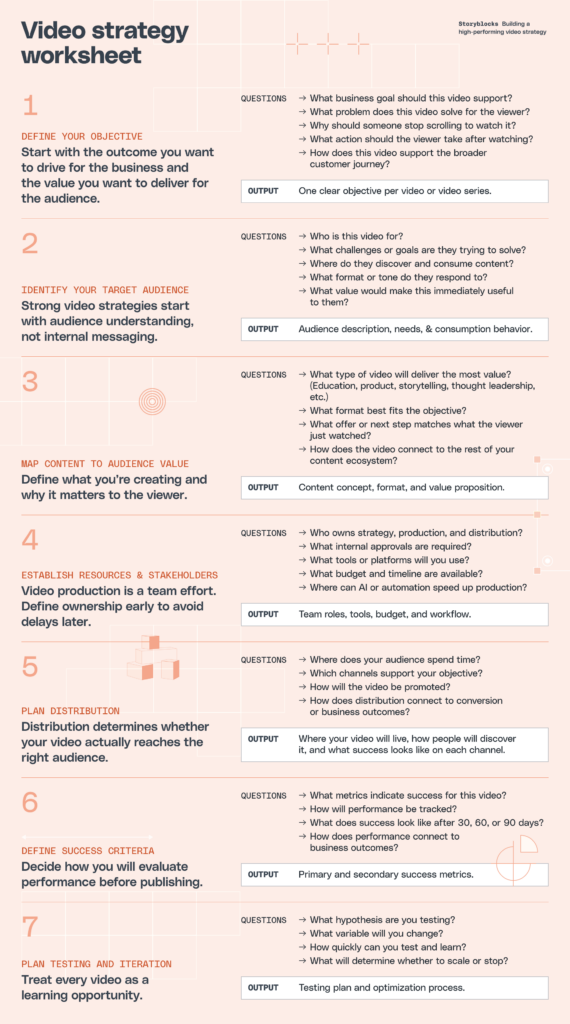
Video strategy worksheet
A video strategy only works if your team can apply it consistently. This worksheet helps you translate the framework in this guide into clear decisions, priorities, and next steps.
Use it as a working document. Run through the questions with your team. Revisit it regularly as your strategy evolves.
Best practices: Other things to consider
These are practical reminders drawn from the strategy principles throughout this guide. Use them as checkpoints when building or reviewing your video plan.
Match content, audience, and offer: Create a clear connection between what the viewer watches and what they’re asked to do next. Relevant content will persuade your audience to engage and convert.
Reduce unnecessary approvals and handoffs: Too many stakeholders slow production and dilute creative direction. Define clear ownership and streamline feedback loops so you can ship content faster without losing clarity.
Plan the offer early: Define the next step or conversion path while planning the video, not after production. If the offer is an afterthought, your audience will be confused about next steps, and ultimately bounce.
Balance data with human storytelling: Performance data matters, but your viewers will still respond to personality, relationships, and narrative.
Use AI strategically: Use AI to accelerate research, editing, packaging, and production support, but not to replace creative judgment.
Learn from creators and publishers: Look beyond traditional brand marketing for inspiration. Independent creators often identify emerging formats and audience expectations first.
Focus on repeatable systems: Sustainable video strategies rely on consistent workflows, clear processes, and ongoing iteration.
Introducing Storyblocks
You’ve seen what it takes to build a contemporary video strategy — from defining objectives and workflows to scaling production and measuring impact. The next step is having the right tools to support that work.
Storyblocks is a stock media platform designed to help teams produce more video, more efficiently. Our subscription model gives creators and organizations access to an extensive library of stock media, templates, and creative tools that support every stage of the video process.
We built Storyblocks to remove common barriers in video production — complex licensing, limited asset access, and workflows that slow teams down. With flexible licensing and unlimited downloads, your team can create, test, and scale video content without restrictions.
Whether you’re planning campaigns, producing content, or iterating on what works, Storyblocks helps support a faster, more consistent video workflow — so your team can focus on creating videos that deliver real results.
Kickstart your video strategy
Storyblocks is the only video production platform that includes truly unlimited stock media. Empower your team to take back creative control with everything they need to create amazing video, faster than ever.
Explore more video resources
If you want to go deeper, these resources further explore the operational and creative tensions that shape successful video programs today: